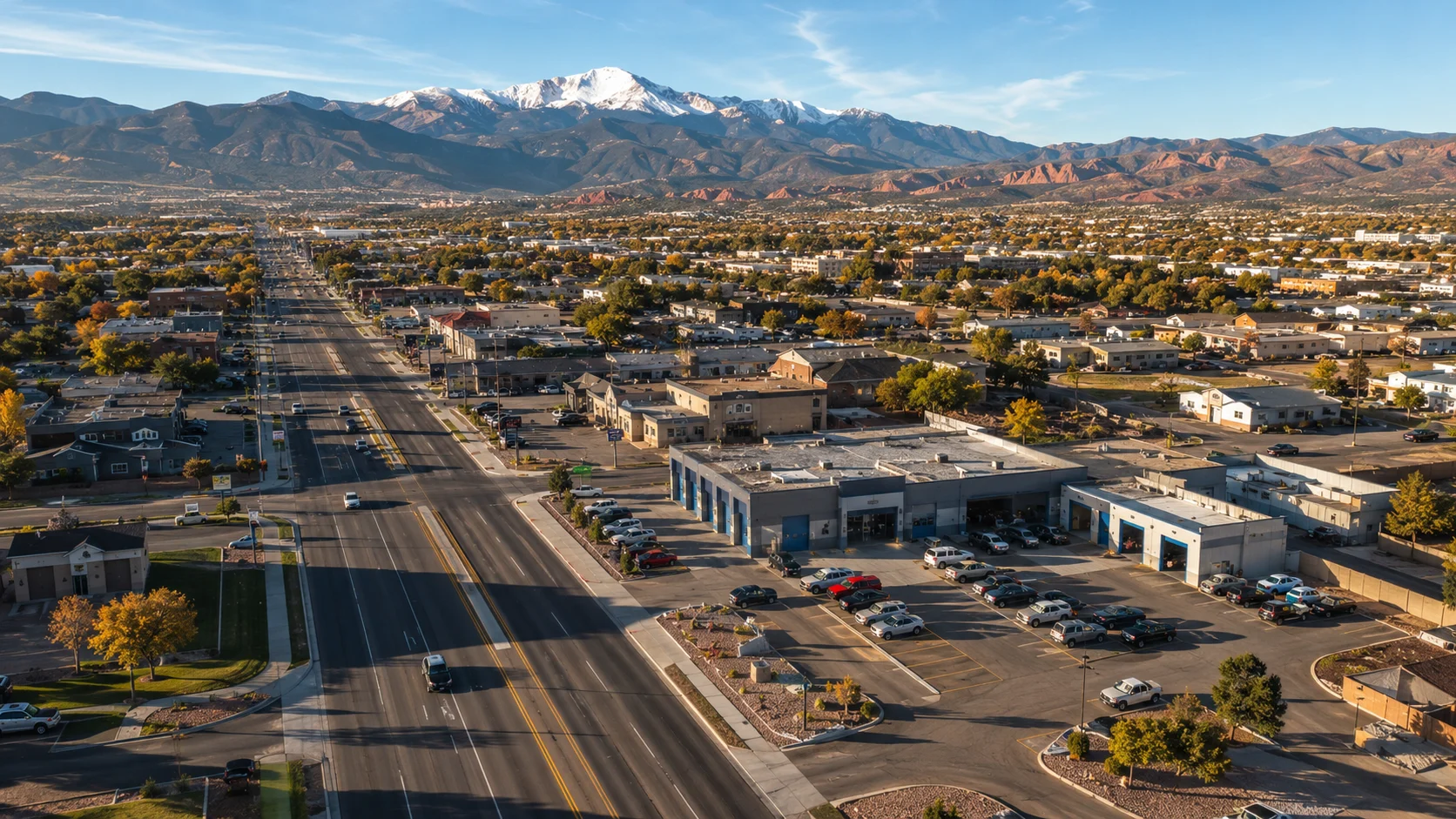
Colorado Springs, CO
Brake Repair
Brakes are the repair people get talked into soonest and understand least. A pad has a wear surface you can measure, and there is a real number for when it needs replacing - so there is no reason for you to take anyone's word for it. We measure yours, tell you the number, and if it is still fine we tell you that instead.
(719) 630-8377What you might be noticing
- A squeal that appears when you brake and disappears when you stop
- A grinding sound - this one means stop driving and call
- The pedal feels soft, spongy, or sinks toward the floor
- Pulsing or shuddering through the pedal when slowing from speed
- The car pulls to one side under braking
- The brake or ABS light stays on
How we do the job
- 01
Measure, do not guess
Pads come off and get measured. New pads start around 10-12mm of friction material; most manufacturers call for replacement around 3mm. If yours read 6mm, you have most of a year left and we will say so rather than selling you a job today.
- 02
Check the rotors against spec
Every rotor is stamped with a minimum thickness. We measure yours and compare. Above spec and in good shape, they stay. Below it, or scored and heat-checked, they get replaced - because machining a rotor that is already near minimum just puts you back here sooner.
- 03
Look past the pads
A pull to one side is usually a sticking caliper or a collapsed flex hose, not the pads. Pulsing is usually runout, not warping. Getting this right is the difference between fixing the problem and replacing parts until it goes away.
- 04
Fluid, honestly assessed
Brake fluid absorbs water over time, which lowers its boiling point - and that matters more here than in most places, because a long descent works brakes hard. We test it rather than flushing it on a calendar.
- 05
Bed them in and road-test
New pads and rotors need a proper bedding-in procedure to transfer an even layer of friction material. Skipping it is the most common cause of a shudder in brakes that are only a month old. We do it before you get the keys.
What it costs
Front pads and rotors on a common sedan or crossover is one of the more predictable jobs we quote. It moves with the vehicle - larger trucks, performance brakes and anything requiring an electronic parking brake retraction take longer. What we will not do is quote you for four corners when only the front axle needs doing. Call with your year, make and model.
Common questions
- Do I have to replace the rotors every time I do pads?
- No. That is a shop habit, not a rule. If the rotors measure above minimum thickness and the surface is even, new pads on existing rotors is a perfectly good repair. We measure and tell you which case you are in.
- My brakes squeal but they stop fine. Is that urgent?
- Usually not urgent, but worth looking at. Many pads have a wear indicator - a small metal tab designed to squeal when material gets low. It is doing exactly what it was built to do. Grinding is different: that is metal on metal and it means the pads are gone.
- Does living in Colorado Springs wear brakes faster?
- It can. The city sits around 6,000 feet with real grades in and west of town, and sustained downhill braking puts far more heat into pads, rotors and fluid than flat-country driving does. If you regularly come down off the passes, brakes are worth checking more often than the sticker suggests.
- How long does it take?
- Front pads and rotors is normally a same-day job. If a caliper or a hydraulic line needs replacing, or a part has to come in, it may be longer - and we will tell you that when we quote it, not after.